
 By Callumlangham@gmail.com
Inner logic lacking in fantasy epic
Born on this day (August 24) in 1973, Barret Oliver was just nine years old when he went on location in Vancouver to star in the “real world” scenes for the multimillion-dollar fantasy The Neverending Story (1984).
Friday July 20, 1984
THE NEVERENDING STORY. Co-written by Herman Weigel, based on Michael Ende’s 1979 novel Die unendliche Geschichte. Music by Klaus Doldinger and Giorgio Morodor. Co-written and directed by Wolfgang Petersen. Running time: 92 minutes. General entertainment with the B.C. Classifier’s warning: occasional scenes may frighten very young children.
THE LAST TIME GERMAN producers spent this much money on a film, they were out to prove a point. To celebrate the 10th anniversary of the Third Reich, Joseph Goebbels issued a blank cheque to the UFA studios to make Munchhausen Abenteur (Baron Munchausen; 1943), an all-colour fantasy, designed to show off the Ministry of Propaganda’s ability to make successful entertainment features.
Forty-one years later [1984], director Wolfgang Petersen’s The Neverending Story wants to make a similar point. Produced in English for the world market, his $27-million special-effects epic is aimed at the same mass audience that embraced E.T. and the Star Wars trilogy.
Goebbels’s investment was pretty much in vain, given the limited market for Reichcinema the year of Munchhausen‘s release.
Petersen’s backers are likely to do considerably better, benefiting not only from international distribution, but from the public’s current interest in youth-oriented escapist fare.
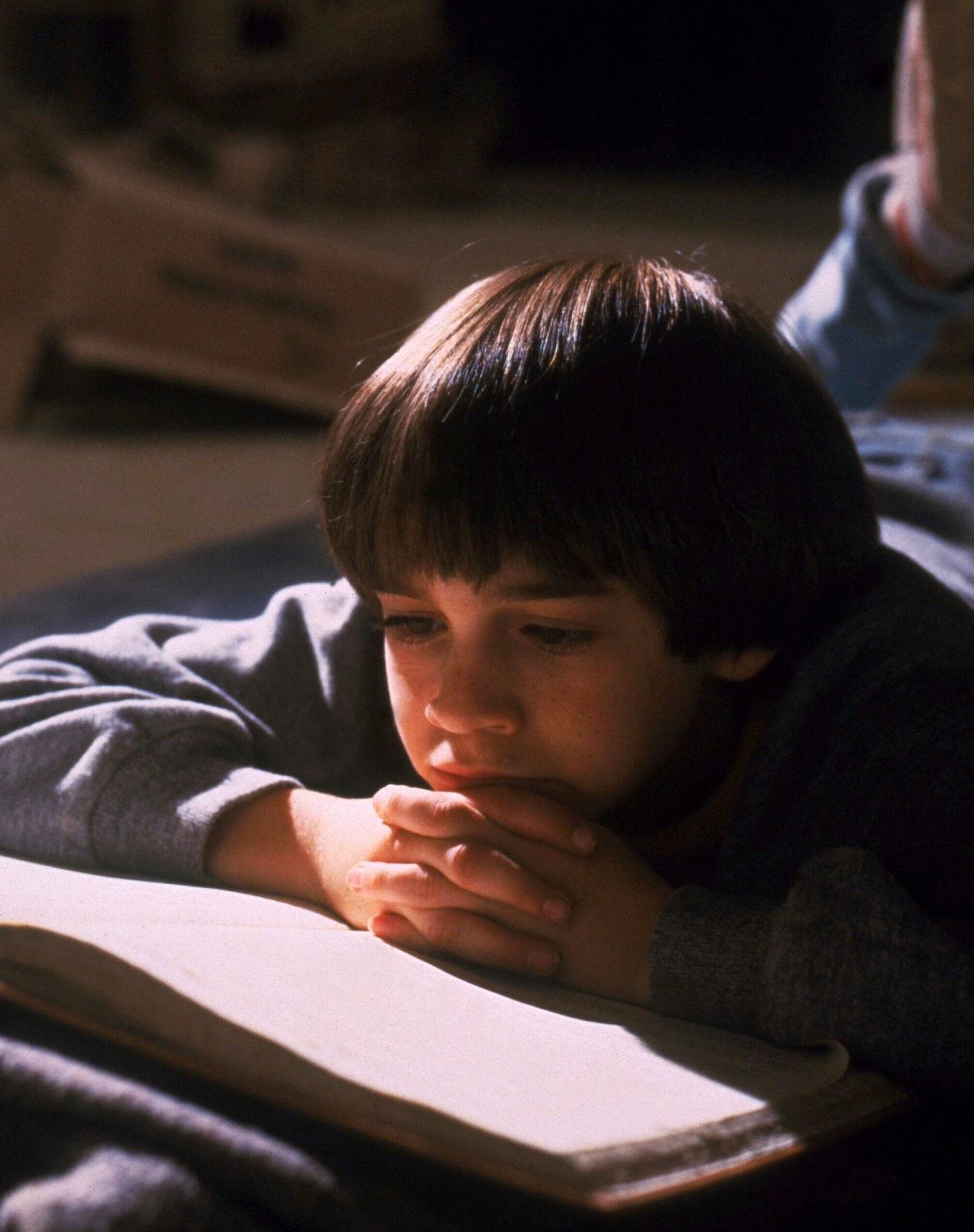
Small boys are the central figures here. Petersen begins by introducing us to 10-year-old Bastian (Barret Oliver), a bookish lad on the run from a trio of schoolyard bullies (Drum Garrett, Darryl Cooksey and Nicholas Gilbert).
Bastian takes temporary refuge in a cluttered bookshop, where Koreander (Thomas Hill), the eccentric proprietor, excites his curiosity with an ornately decorated volume called The Neverending Story. The kid steals the book and hides out in the school’s attic, where he begins reading about Fantasia, a magical land that is gradually being consumed by a mysterious form of destruction called “The Nothing.”
The movie’s technique is to show us the story that Bastian is reading. Together, we meet Atreyu (Noah Hathaway), the child warrior who undertakes a great quest against The Nothing in order to save his world, and the life of his Empress (Tami Stronach).
Like Munchhausen director Josef von Baky, Petersen drew his inspiration from a literary source. The Neverending Story is based on Michael Ende’s 1979 German-language best-seller, a work that has developed a Lord of the Rings-like cult following overseas.
Like J.R.R. Tolkein, Ende takes his work very seriously. On seeing Petersen’s adaptation, the novelist insisted that his name be removed from the film.
Petersen is also serious. His approach, however, is to go at the material with the slow-witted solemnity of an unimaginative children’s librarian, conscious of his responsibility to provide pre-teens with wholesome, non-alarming entertainment laden with all the proper values.
“Basically,” says Petersen in the film’s press notes, the movie “has to do with the importance of imagination, with the idea that if people don’t dream anymore, don’t create their own inner world in contrast to the dull everyday existence around them they won’t survive.”
The director’s fine sentiments are belied by his own rather bland creation. Fantasia looks like an expanded version of Ronald McDonaldland. A place with no obvious inner logic, its only function is to look like a fairy-tale illustration because, what the heck, it’s “just for kids.”
In place of hamburger sales, Petersen is promoting the idea that books are good and that children really should learn to read. Stolidly European, the best that can be said for The Neverending Story is that it is an improvement on The Smurfs.
The above is a restored version of a Province review by Michael Walsh originally published in 1984. For additional information on this archived material, please visit my FAQ.
Afterword: Los Angeles-born child actor Barret Oliver had three features, a made-for-TV movie and five TV series episode appearances to his credit when Wolfgang Petersen cast him as Bastian Bux. Although his performing career lasted only nine years, it included a featured part in Ron Howard’s Cocoon (1985) and its sequel Cocoon: The Return (1988), as well as the title role in D.A.R.Y.L. (1985), in which he played an android. Internet sources say that he became seriously involved with the cult-like Church of Scientology in 1989. He developed his interests in photography and printing to the point where he was able to teach classes in the former and publish A History of the Woodburytype, a 2007 coffee table book, about the latter. Oliver’s Neverending Story character, Bastian, was played by Jonathan Brandis in the first sequel, The Neverending Story II: The Next Chapter (1994), and by Jason James Richter in the final instalment, The Neverending Story III (1994). All three performed on the same Gastown locations in downtown Vancouver. Drum Garrett, the young actor who torments Oliver’s Bastion (as Bully No. 1), was cast in Vancouver. He would go on to roles in such B.C.-made TV series as Danger Bay and 21 Jump Street. Now known as Chris Eastman, his more recent work includes parts on Supernatural and Fringe.