 By Callumlangham@gmail.com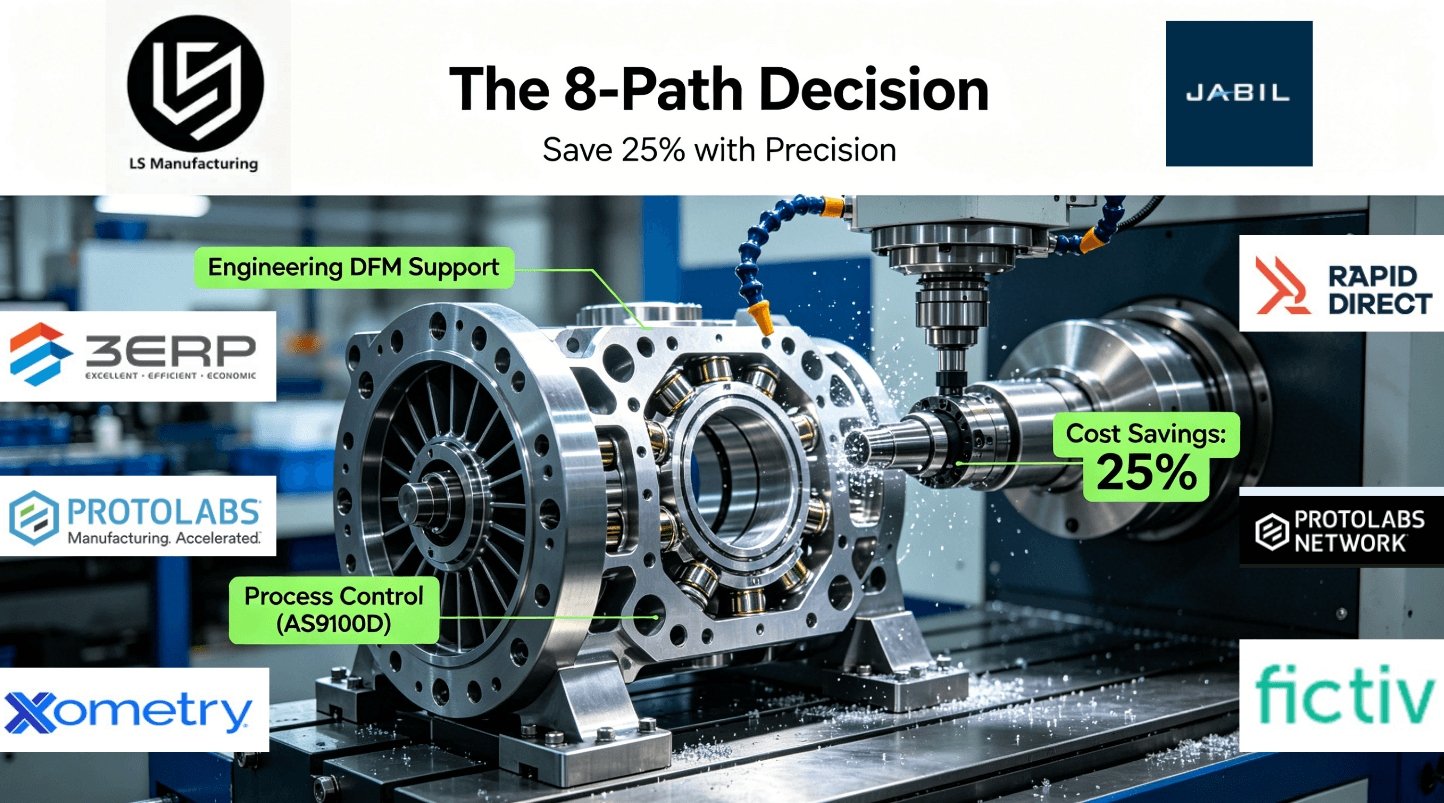
Introduction
In the high-stakes world of industrial manufacturing, engineers face a relentless dilemma: the demand for complex parts milling with tight tolerances is soaring, yet traditional production methods often lead to precision loss and budget overruns. The core issue isn’t a lack of machine tools, but a gap in technical decision-making — many suppliers lack the deep DFM (Design for Manufacturability) expertise needed to transform a blueprint into a reliable masterpiece without costly trial and error.
This article cuts through the noise by benchmarking the top precision CNC milling manufacturers. We dissect how leading players leverage advanced technical capabilities and rigorous quality systems to overcome geometric challenges and deliver substantial cost savings. By understanding the strategic strengths of each, you can navigate from prototype to production with confidence, ensuring your projects meet both performance and financial targets.
Why is Protolabs the Industry Benchmark for Prototype Milling Services and Speed?
Protolabs has established itself as the go-to solution for rapid iteration, setting the standard for speed in the prototype milling services sector. Its highly automated digital quoting and manufacturing platform can turn around machined parts in as little as one day. This speed is invaluable during the Building Blocks of Innovation phase, allowing engineers to validate designs and test form, fit, and function with unprecedented agility. However, for highly complex geometries requiring extensive multi-axis strategies, its automated approach may have limitations compared to specialized engineering-driven suppliers.
- The Digital Instant Quote Engine: Protolabs’ core strength lies in its proprietary software that automates the quotation and DFM analysisp Engineers can upload a 3D model and receive an interactive quote with manufacturability feedback within hours. This system drastically reduces the traditional back-and-forth communication, accelerating the prototype milling services timeline and allowing for faster design validation cycles in critical project phases.
- Standardized Process for Predictable Outcomes: By standardizing materials, tooling, and machining parameters across a vast network, Protolabs achieves remarkable consistency. This “manufacturing as a service” model ensures that a prototype ordered today will be dimensionally identical to one ordered next month. This predictability is crucial for engineers who need reliable building blocks of innovationwithout the variability often associated with traditional machine shops.
- Limitations for High-Complexity Work: While excellent for speed and standard prototypes, the automated nature of the service can struggle with extremely complex, free-form surfaces or parts requiring advanced 5-axis simultaneous machining. The lack of deep, human-led DFM engineeringon the front end can sometimes result in suboptimal toolpath strategies for the most challenging complex parts milling
How Do Fictiv and Hubs Redefine Machining for the Big Screen via Digital Supply Chains?
Fictiv and Hubs (now part of Protolabs) pioneered the digital manufacturing network model, redefining how engineers source precision CNC milling. They connect customers with a global network of vetted manufacturers through a single digital platform. This model provides unparalleled flexibility and competitive CNC milling quote options, effectively creating a “digital supply chain” for hardware development. As noted in McKinsey’s analysis of manufacturing trends, such digital ecosystems are critical for resilience and accessing specialized capabilities on demand.
1. Network Effects and Capacity Scaling
The primary advantage of the Fictiv and Hubs model is the ability to tap into a vast, distributed pool of manufacturing capacity. This is particularly beneficial for projects requiring large volumes or specialized machines that a single local shop may not possess. When you request a CNC milling quote, the platform’s algorithm matches your part’s geometry with the best-suited machine and operator within its network, optimizing for both cost and capability.
2. Quality Control in a Distributed Model
A common concern with network-based models is quality consistency. Both platforms address this with stringent partner vetting, standardized inspection protocols, and centralized project management. They act as the quality gatekeeper, ensuring that parts arriving from various network partners meet the specified precision CNC milling requirements, though the level of The Art of Tight Tolerances expertise can vary significantly between individual network partners.
3. The Digital Thread and Data Management
These platforms excel at creating a transparent “digital thread” for the entire manufacturing process. From initial CNC milling quote to final inspection data, all project information is stored and accessible online. This aligns with Industry 4.0 principles, providing engineers with a clear audit trail and simplifying the management of complex, globalized precision CNC milling projects.
Can Jabil Meet the Rigorous Requirements for Complex Parts Milling in Modern Industry?
Jabil brings a vastly different proposition as a global manufacturing conglomerate. Its strength is not just in complex parts milling but in providing end-to-end solutions that span from initial design assistance to full-scale production and supply chain management. For projects requiring engineering the unseen levels of integration — where the milled part is one component of a larger electronic or mechanical assembly — Jabil’s vertical capabilities are a significant advantage.
1. Vertical Integration for Complex Assemblies
Jabil’s ability to handle complex parts milling is enhanced by its control over adjacent processes like injection molding, PCB fabrication, and final assembly. This eliminates the friction of dealing with multiple suppliers and ensures that the machined component is perfectly designed to interface with other parts of the product. This is true Engineering the Unseen, where the supplier’s broad capability set de-risks the entire product realization process.
2. High-Volume Precision and Replication
Unlike prototype-centric shops, Jabil is built for scale. Its manufacturing facilities are equipped to run high-volume precision CNC milling operations with strict process controls. This makes it an ideal partner for products that transition from low-volume prototyping to mass production, ensuring consistency across hundreds of thousands of parts through statistical process control (SPC) and advanced quality systems.
3. The Challenge of Agility and Cost
The trade-off for Jabil’s scale and vertical integration can be agility and cost-effectiveness for very low-volume projects. The overhead of its extensive quality systems and corporate structure can make its CNC milling quote less competitive for one-off prototypes or small-batch runs compared to specialized prototype milling services. Its sweet spot is complex, high-volume industrial and consumer electronics applications.
Does 3erp Offer Specialized Technical Solutions for The Art of Tight Tolerances?
3ERP (3D Engineering Rapid Prototyping) has carved out a niche by focusing on the technical challenges of the art of tight tolerances. It positions itself as a service provider that offers deep engineering support for challenging materials and geometries. For engineers struggling with warping thin-walled parts or achieving a perfect surface finish on difficult alloys, 3ERP’s hands-on approach provides a valuable alternative to fully automated platforms. When evaluating such specialized custom milling services, it’s critical to assess their technical documentation and willingness to engage in pre-production DFM discussions.
1. Material Expertise and Finishing Mastery
3ERP demonstrates strong capability in machining a wide range of engineering-grade materials, including challenging ones like PEEK, titanium, and high-strength aluminum alloys. Its focus on The Art of Tight Tolerances is evident in its post-processing and finishing services, which can achieve cosmetic-grade surfaces and precise anodized colors that are often required for consumer-facing products.
2. Engineering-Led DFM Support
A key differentiator is the access to experienced manufacturing engineers who provide proactive DFM feedback. Rather than relying solely on automated software, 3ERP’s team manually reviews designs for potential issues like tool access, thin-wall stability, and optimal fixturing. This human-led DFM is essential for pushing the boundaries of complex parts milling and avoiding costly redesigns.
3. Balancing Speed and Complexity
While 3ERP offers rapid prototyping services, its true value is unlocked with complex, low-to-medium volume production runs where engineering nuance matters more than sheer speed. It strikes a balance between the agility of prototype milling services and the technical depth of a high-end production shop, making it a strong choice for functional prototypes and bridge production.
How Do Xometry and Rapiddirect Support Global Precision CNC Milling Services?
Xometry and RapidDirect are major players in the on-demand manufacturing space, providing extensive precision CNC milling services on a global scale. Their business models emphasize accessibility, instant quoting, and a wide range of material and finishing options. They serve as powerful engines for sourcing custom parts quickly, but the consistency in achieving tight tolerances can be variable due to the diverse nature of their manufacturing partners.
1. Massive Scalability and Instant Accessibility
The primary strength of Xometry and RapidDirect is their ability to handle an enormous volume and variety of projects simultaneously. Their platforms are designed for ease of use, offering instant CNC milling quote generation based on uploaded 3D models. This scalability makes them a reliable backup or primary source for a wide range of precision CNC milling needs, from simple brackets to moderately complex enclosures.
2. Geographic Reach and Lead Time Optimization
With manufacturing partners spread across different time zones, these platforms can often optimize for lead time by routing jobs to facilities with available capacity. This global footprint is a significant advantage for companies needing to support multiple geographic markets or requiring urgent custom milling services outside of local business hours.
3. The Consistency Challenge at the Extremes
For standard tolerances (±0.1 mm or looser), these platforms perform well. However, when projects demand tight tolerance milling (e.g., ±0.025 mm or better) or involve very complex parts milling with critical datums, the results can be inconsistent. The quality ultimately depends on the specific machine shop within the network that is assigned the job, which may not always have the specialized equipment or AS9100D-level process discipline required for mission-critical components.
Is Your Design Optimized for Rapid CNC Milling Without Sacrificing Quality?
Achieving cost savings and speed in rapid CNC milling is not just about the manufacturer; it’s about the design itself. Proper DFM is the most powerful tool for reducing costs and improving quality. Adhering to standardized geometric dimensioning and tolerancing principles, as defined by the ASME Y14.5 standard, is fundamental to ensuring designs are manufacturable and inspectable, preventing misinterpretation and costly rework.
- Designing for the Toolpath: Effective DFMfor milling involves understanding the constraints of the cutting tool. This includes specifying appropriate internal corner radii (avoiding sharp 90-degree internal corners), minimizing deep pockets that require long-reach tools (which deflect and reduce precision), and designing features that can be machined with the fewest setups possible. A design optimized for the toolpath is inherently optimized for rapid CNC milling.
- The Language of Precision: GD&T: Mastering The Art of Tight Tolerancesrequires using Geometric Dimensioning and Tolerancing (GD&T) c Applying ASME Y14.5 standards — such as using profile tolerances to control complex surfaces and datum structures to define part function — ensures that the CNC precision milling parts manufacturer understands the design intent clearly. This reduces ambiguity and prevents the “over-tolerancing” that unnecessarily drives up machining costs.
- The Cost of Over-Engineering: A common source of the 25% cost waste mentioned in the title is over-engineering. This includes specifying surface finishes tighter than functionally required, applying general tolerances that are unnecessarily tight, or designing monolithic parts that would be cheaper and easier to manufacture as assemblies. A rigorous DFMreview with a qualified CNC precision milling parts manufacturer can identify these areas and deliver the promised savings without compromising the part’s function.
Why Does a Specialized Precision Milling Supplier Outperform Platforms for Tight Tolerances?
When the primary requirement is achieving and holding tight tolerances on complex, mission-critical components, specialized precision milling suppliers consistently outperform generalized platforms. The reason is a fundamental difference in approach: specialization versus generalization. A specialized supplier invests in the specific equipment, metrology tools, and quality culture necessary for tight tolerance milling, often backed by AS9100D certification, which mandates a level of process control that is difficult to enforce across a large, distributed network.
1. The Culture of Metrology and Process Control
A specialized precision CNC milling supplier treats measurement as a core competency, not an afterthought. They invest in high-end Coordinate Measuring Machines (CMMs), optical comparators, and surface roughness testers. More importantly, they implement Statistical Process Control (SPC) to monitor machining processes in real-time, catching deviations before they result in scrap. This culture is essential for tight tolerance milling and is a hallmark of AS9100D certified facilities.
2. Deep Technical Partnership and Problem Solving
Unlike transactional platform relationships, a specialized supplier acts as a technical partner. Their engineers have deep expertise in tool selection, fixturing design, and machining strategies for challenging materials. When a complex parts milling issue arises, they can collaboratively troubleshoot the root cause — be it tool chatter, thermal deformation, or fixturing stress — rather than simply rejecting the part or charging a premium for rework.
3. The AS9100D and IATF 16949 Advantage
Certifications like AS9100D (aerospace) and IATF 16949 (automotive) are not just paperwork; they enforce a rigorous framework for quality management. For tight tolerance milling, this means mandatory First Article Inspection (FAI) reports, full material traceability (MTRs), and closed-loop corrective action systems. This level of documentation and control provides the certainty needed for high-risk projects, which is often lacking in platform-based custom milling services.
How Does LS Integrate AS9100D Excellence into Precision CNC Milling?
A prime example of a specialized supplier is one that integrates aerospace and automotive-level quality systems directly into its precision CNC milling operations. Such a manufacturer, holding AS9100D and IATF 16949 certifications, builds its processes around risk mitigation and continuous improvement. This approach is critical for applications where failure is not an option, and it provides a level of precision behind the scenes that generic shops cannot match. Partnering with a dedicated CNC precision milling parts manufacturer of this caliber ensures that every step, from raw material certification to final inspection, is governed by a documented, auditable system.
1. Process-Oriented Quality Management
The foundation of excellence is a process-oriented quality system. This means that instead of relying solely on final inspection to catch defects, the entire manufacturing process is designed to prevent them. For precision CNC milling, this includes validated machining parameters for different materials, calibrated equipment schedules, and mandatory in-process inspections. This proactive approach, mandated by AS9100D, is what delivers consistent from blueprint to masterpiece results.
2. Advanced Capability for Complex Geometries
Suppliers focused on excellence invest in advanced machinery, such as 5-axis CNC milling centers with high-pressure coolant and torque-controlled spindles. This equipment is essential for complex parts milling as it allows for machining intricate features in a single setup, eliminating the cumulative errors associated with repositioning the workpiece. This capability, combined with AS9100D discipline, is how they achieve the ±0.005 mm tolerances required for demanding industrial applications.
3. The Engineering Support Difference
The integration of excellence extends to the front-end engineering support. A top-tier CNC precision milling parts manufacturer will assign experienced engineers to conduct thorough DFM reviews. They will analyze the part’s function, suggest design modifications to enhance manufacturability and reduce cost, and plan the machining strategy to ensure the tight tolerances are held reliably throughout the production run. This collaborative engineering is the key to unlocking the 25% cost savings.
Conclusion
Precision CNC milling is far more than a mechanical process; it is a discipline that blends advanced engineering with rigorous quality management. The journey From Blueprint to Masterpiece requires a strategic partnership with a manufacturer whose capabilities align with the project’s technical demands. By understanding the distinct strengths of the leading players — from the speed of Protolabs to the specialized AS9100D excellence of integrated suppliers — engineers can make informed technical decisions that safeguard performance, accelerate timelines, and realize the promised 25% cost savings. In the world of high-performance manufacturing, the right partner is the ultimate precision behind the scenes.
FAQs
How can I verify a Precision CNC Milling Manufacturer’s capability for aerospace parts?
A: The primary verification is the AS9100D certification, which is specific to aerospace. Beyond the certificate, request a First Article Inspection (FAI) report and Material Test Reports (MTRs) for traceability. A capable supplier will have these documents readily available and will integrate them into their quality management system as standard practice.
Why is IATF 16949 certification critical for tight tolerance milling?
A: IATF 16949 emphasizes Statistical Process Control (SPC) and a “zero-defect” mentality. For tight tolerance milling, this means the supplier is proactively monitoring the machining process to prevent deviations, rather than just inspecting finished parts. This systemic approach is more reliable than a simple CNC milling quote for ensuring long-term consistency.
What are the risks of choosing custom milling services solely based on an instant quote?
A: Instant quotes often miss critical DFM issues like thin-wall distortion, tool access limitations, or inappropriate tolerance stacking. Choosing solely on price can lead to parts that fail to function, require expensive redesigns, or incur hidden costs for rework and expedited shipping, negating any initial savings.
How does rapid CNC milling support sustainable engineering innovation?
A: Rapid CNC milling enables on-demand manufacturing, which reduces the need for large inventories and minimizes material waste from overproduction. By producing parts only as needed and optimizing material usage through advanced nesting software, it aligns with sustainable engineering principles and builds a more resilient supply chain.
Can LS handle complex parts milling with 0.005mm tolerances?
A: Yes. With advanced 5-axis machining capabilities and a quality system built on AS9100D and IATF 16949 principles, they are equipped to handle such demanding tolerances. Their process includes rigorous in-process inspection and SPC to ensure that even the most complex parts milling projects meet the specified precision requirements consistently.
Author Bio
The author is a seasoned manufacturing expert specializing in high-precision machining and quality management systems. With a background in aerospace and automotive engineering, the author provides strategic insights into selecting and collaborating with precision CNC milling manufacturers to optimize design for manufacturability and achieve significant cost savings. The expert’s affiliated organization, LS Manufacturing, operates under AS9100D and IATF 16949 certified processes, delivering custom milling services that meet the most stringent industry standards. To leverage this expertise for your next project, upload your design files for a complimentary DFM analysis and CNC milling quote.